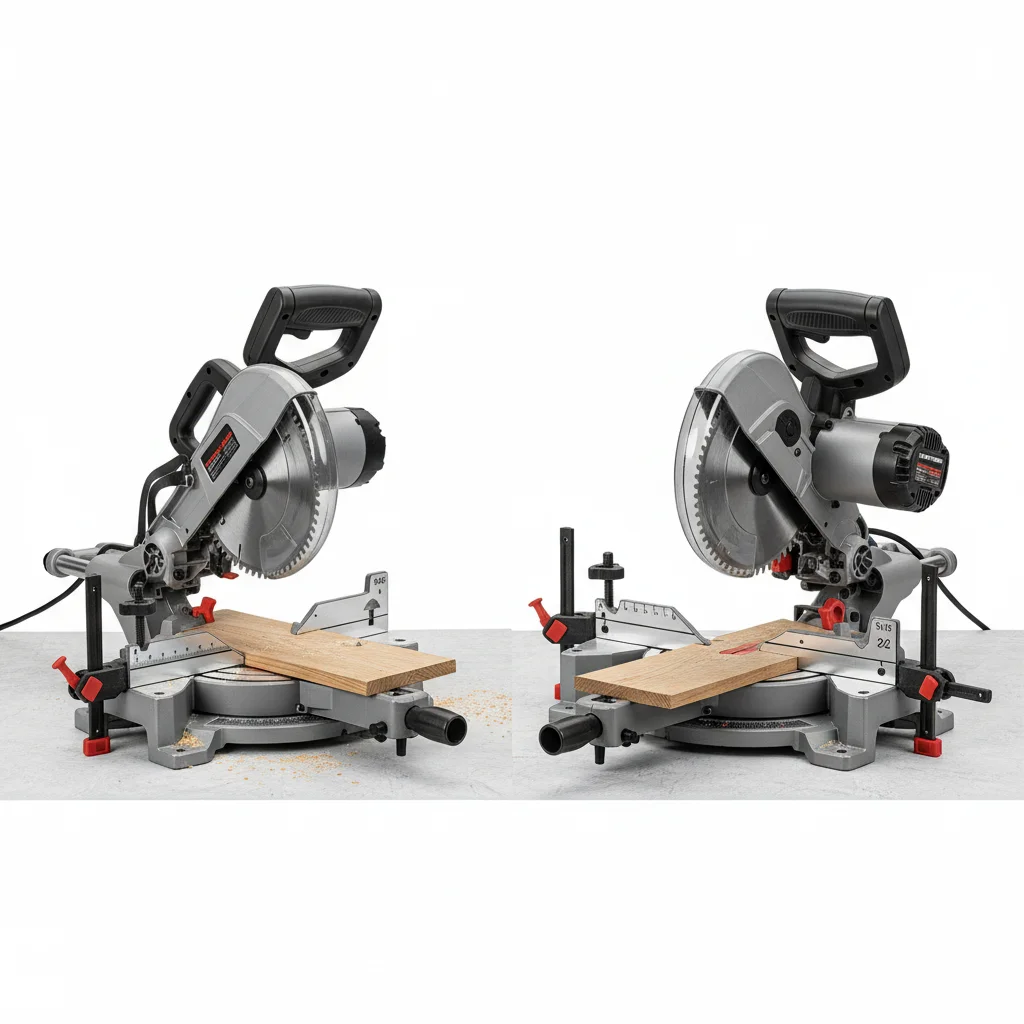
Understanding the difference between a miter saw’s bevel and compound cutting capabilities is crucial for achieving precise angles in your woodworking projects. A miter saw with a bevel feature allows the blade to tilt to the left or right, creating angled cuts on the face of the material, while a compound miter saw combines both miter (horizontal angle) and bevel (vertical angle) adjustments simultaneously, enabling complex cuts like those needed for crown molding. There are three main types of miter saws when considering these features: standard miter saws (miter only), single-bevel compound miter saws, and dual-bevel compound miter saws.
What is a Bevel Cut?
A bevel cut is an angled cut made across the thickness of a board, where the blade tilts relative to the saw’s base. This type of cut is essential for creating sloped edges, such as those found on trim, picture frames, or cabinet components. Most miter saws offer a bevel range from 0 to 45 degrees, and some can even go up to 48 or 50 degrees for more extreme angles. The ability to bevel is a fundamental feature for many common woodworking tasks.
Understanding Compound Cuts
A compound cut is a combination of a miter cut and a bevel cut performed in a single pass. This means the blade is angled both horizontally (miter) and vertically (bevel) at the same time. Compound cuts are particularly useful for intricate joinery, such as fitting crown molding or creating complex box joints, where two angled surfaces meet. Without a compound feature, these cuts would require multiple passes or specialized jigs, significantly increasing complexity and potential for error.
Single-Bevel vs. Dual-Bevel Compound Miter Saws
|
Our Picks for the Best Miter Saw in 2026
As an Amazon Associate I earn from qualifying purchases.
|
||
| Num | Product | Action |
|---|---|---|
| 1 | Stanley 1-20-600 Saw Storage Miter Box with Saw, Black |

|
| 2 | Makita LS0816F 8-1/2” Slide Compound Miter Saw |
|
| 3 | Seesii Mini Circular Saw with Laser Guide,4.8A 4000 RPM Compact Corded Circular Saw with Rip Guide,3 Blades (4-1/2") for Wood,Soft Metal,Tile,Plastic Cutting,Max Cut Depth 1-11/16"(90°),1-1/8" (45°) |
|
| 4 | Metabo HPT 12-Inch Compound Miter Saw | Xact Cut LED Shadow Line System | Dual Bevel | C12FDHB |
|
| 5 | WEN MM0713 9.5-Amp 7.25-Inch Single Bevel Compact Sliding Compound Miter Saw with LED Cutline Guide, Black |
|
| 6 | Olson Saw 35-241 Fine Kerf Saw 35-550 42 tpi with Aluminum Thin Slot Miter Box, Slot Size .014-Inch, Slot Angles 45, 60, 90, Cutting Depth 7/8-Inch, Pack of 1 |
|
| 7 | Miter Saw Laser Guide - Miter and Portable Saw Laser Guide, Miter & Portable Saws |
|
| 8 | WEN Universal Collapsible Miter Saw Stand, 350-Pound Capacity (MSA200) |
|
| 9 | SKIL 3601-02 Flooring Saw with 36T Contractor Blade, Red and black |
|
| 10 | HAUTMEC 14 Inch Clamping Miter Box with Adjustable Jaw & 4 Anti-Slip Clamps, Heavy Duty ABS Mitre Saw Box with 22.5°, 45°, 90° Cutting Angles for Woodworking, Trim, Frames, DIY Projects – HTHDM25036 |
|
The distinction between single-bevel and dual-bevel compound miter saws lies in their flexibility. A single-bevel saw can only tilt the blade in one direction (typically to the left), meaning you often have to flip your workpiece to make opposing bevel cuts. This can be cumbersome and less precise for longer pieces. In contrast, a dual-bevel saw can tilt the blade both left and right, allowing you to make all necessary cuts without reorienting the material. This significantly speeds up workflow and improves accuracy, especially for repetitive tasks.
- Single-bevel saws require flipping the workpiece for opposing angles.
- Dual-bevel saws offer greater convenience and accuracy for complex cuts.
- Consider the type of projects you’ll undertake when choosing.
- Dual-bevel models generally come at a higher price point.
- For occasional DIY, a single-bevel might suffice; for frequent work, dual-bevel is superior.
When to Choose Each Type
For basic crosscuts and simple mitered joints, a standard miter saw or a single-bevel compound miter saw will often suffice. These are excellent for framing, deck building, and basic trim work where complex angles are less frequent. However, if your projects frequently involve crown molding, intricate trim work, or furniture making that demands precise compound angles, a dual-bevel compound miter saw is an invaluable tool. The time saved and the increased accuracy it provides can significantly improve the quality and efficiency of your work.For those on a tighter budget or with limited space, a single-bevel model can still be highly effective, requiring only a bit more planning and workpiece manipulation.
Key Considerations for Your Purchase
When deciding between these miter saw types, consider the maximum cutting capacity, the motor power, and any additional features like laser guides or dust collection systems. The size of the blade (10-inch vs. 12-inch) will also impact the depth and width of cuts you can make. Always prioritize safety features, regardless of the saw’s bevel capabilities. Reading reviews and comparing models will help you find the best fit for your specific needs and budget.Investing in the right miter saw will ensure your projects are completed with precision and ease.
Get our weekly buyer guide
Practical specs, not advice. Unsubscribe anytime.
