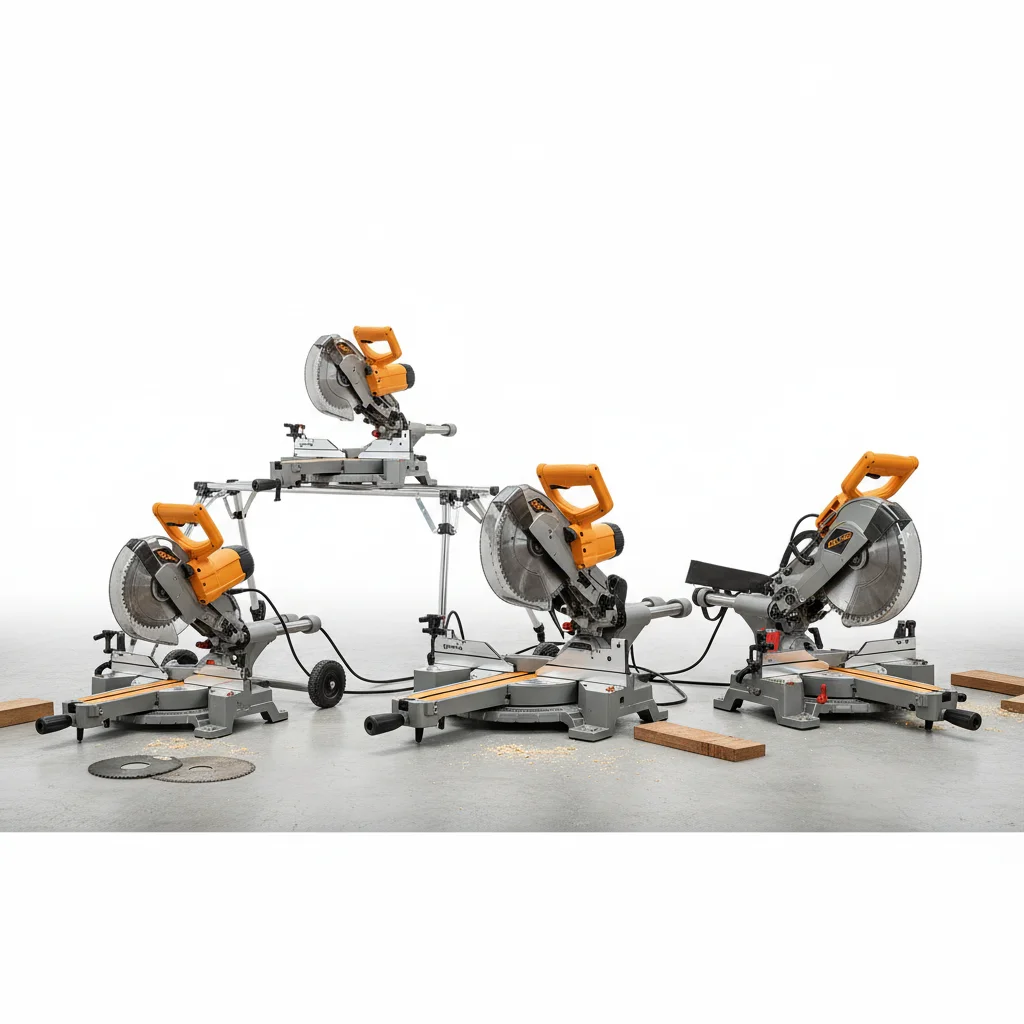
Choosing the right miter saw type is crucial for any woodworking or DIY project, and there are primarily three main types to consider: standard compound, sliding compound, and dual-bevel compound miter saws. Each offers distinct advantages and limitations, making them suitable for different applications and user needs. Understanding these differences will help you make an informed decision that aligns with your specific projects and workshop space.
The standard compound miter saw is the most basic and often the most affordable option. It allows for angled cuts (miter cuts) and tilted cuts (bevel cuts) in one direction. This makes it excellent for basic trim work, picture frames, and other projects where single-direction bevels are sufficient. While effective, its cutting capacity is limited by the blade size, typically handling boards up to 6 inches wide at a 90-degree angle.
Sliding Compound Miter Saws: Extended Capacity
Sliding compound miter saws significantly increase cutting capacity compared to their standard counterparts. They feature rails that allow the saw head to slide forward and backward, enabling them to cut much wider boards, often up to 12-16 inches. This makes them ideal for cutting wider shelving, decking, and larger trim pieces. The sliding mechanism, however, requires more depth in your workshop for operation and storage. They also come in both single and dual-bevel variations.
Dual-Bevel Compound Miter Saws: Enhanced Versatility
Dual-bevel compound miter saws offer the ultimate in versatility. Unlike single-bevel saws that only tilt in one direction, dual-bevel models can tilt both left and right. This eliminates the need to flip your workpiece for opposing bevel cuts, saving time and improving accuracy, especially on intricate projects like crown molding or complex trim work. While generally more expensive, the convenience and efficiency they provide can be invaluable for serious woodworkers.
Cordless Miter Saws: Portability and Convenience
|
Our Picks for the Best Miter Saw in 2026
As an Amazon Associate I earn from qualifying purchases.
|
||
| Num | Product | Action |
|---|---|---|
| 1 | Seesii Mini Circular Saw with Laser Guide,4.8A 4000 RPM Compact Corded Circular Saw with Rip Guide,3 Blades (4-1/2") for Wood,Soft Metal,Tile,Plastic Cutting,Max Cut Depth 1-11/16"(90°),1-1/8" (45°) |

|
| 2 | WEN Universal Collapsible Miter Saw Stand, 350-Pound Capacity (MSA200) |
|
| 3 | Miter Saw Laser Guide - Miter and Portable Saw Laser Guide, Miter & Portable Saws |
|
| 4 | Stanley 1-20-600 Saw Storage Miter Box with Saw, Black |
|
| 5 | Makita LS0816F 8-1/2” Slide Compound Miter Saw |
|
| 6 | HAUTMEC 14 Inch Clamping Miter Box with Adjustable Jaw & 4 Anti-Slip Clamps, Heavy Duty ABS Mitre Saw Box with 22.5°, 45°, 90° Cutting Angles for Woodworking, Trim, Frames, DIY Projects – HTHDM25036 |
|
| 7 | SKIL 3601-02 Flooring Saw with 36T Contractor Blade, Red and black |
|
| 8 | Olson Saw 35-241 Fine Kerf Saw 35-550 42 tpi with Aluminum Thin Slot Miter Box, Slot Size .014-Inch, Slot Angles 45, 60, 90, Cutting Depth 7/8-Inch, Pack of 1 |
|
| 9 | Metabo HPT 12-Inch Compound Miter Saw | Xact Cut LED Shadow Line System | Dual Bevel | C12FDHB |
|
| 10 | WEN MM0713 9.5-Amp 7.25-Inch Single Bevel Compact Sliding Compound Miter Saw with LED Cutline Guide, Black |
|
For those who need to work on job sites or in areas without immediate power access, cordless miter saws are an excellent choice. These saws are powered by rechargeable batteries, offering unparalleled portability. While they might have slightly less power or run time compared to their corded counterparts, advancements in battery technology have made them increasingly capable for a wide range of tasks. They are particularly useful for outdoor projects or when setting up a temporary workshop.
Choosing the Right Size and Features
Beyond the type, consider the blade size (10-inch or 12-inch are common) and additional features like laser guides, dust collection systems, and integrated work clamps. A 10-inch saw is often sufficient for most DIY and hobbyist needs, while a 12-inch saw provides greater cutting depth and capacity for larger stock. Laser guides can improve accuracy, and efficient dust collection is crucial for a clean and safe workspace.
- Consider your most frequent project types (e.g., trim, decking, furniture).
- Evaluate your available workshop space for saw operation and storage.
- Determine if portability is a key requirement for your work.
- Set a budget that aligns with the features and quality you need.
- Research specific models and read user reviews for real-world performance insights.
Maintenance and Longevity
Regardless of the type you choose, proper maintenance is key to extending the life of your miter saw. Regularly clean the saw to remove sawdust and debris, especially from the motor vents and sliding mechanisms. Check and tighten all fasteners periodically, and ensure the blade is sharp and free from damage. Lubricate moving parts as recommended by the manufacturer. A well-maintained saw will perform better and last longer, providing reliable service for years to come.
Get our weekly buyer guide
Practical specs, not advice. Unsubscribe anytime.
