A heavy-duty miter saw is essential for framing due to its precision and power, enabling accurate cuts for sturdy structures. The DeWalt DWS780, Bosch GCM12SD, and Milwaukee M18 FUEL 2734-21 are top models for 2026, offering features like 12-inch blades, 15-amp motors, and dual-bevel sliding capabilities for efficient and precise cuts on large lumber. Selecting the right saw significantly enhances efficiency, accuracy, and overall construction quality.
1. What is a Miter Saw?
A miter saw is a specialized power tool designed to make precise crosscuts and angled cuts in a workpiece, typically wood. It features a circular blade mounted on a hinged, pivoting arm that can be lowered onto the material. While often associated with delicate trim and molding, miter saws are also crucial for structural framing, where they provide the speed and accuracy needed for repetitive cuts on larger timber.
For framing applications, the versatility of miter saws is paramount. They excel at various cut types essential for building robust structures:
- Crosscuts: Straight cuts at a 90-degree angle to the length of the board, fundamental for cutting studs, joists, and rafters.
- Miter Cuts: Angled cuts made by swiveling the blade horizontally, essential for creating tight-fitting corners in framing.
- Bevel Cuts: Angled cuts made by tilting the blade vertically, useful for sloped components like roof rafters.
- Compound Cuts: A combination of both miter and bevel angles, allowing for complex, multi-plane cuts without repositioning the workpiece, which is highly beneficial for intricate framing details.
There are several types of miter saws, each offering different capabilities:
- Standard Miter Saws: The most basic type, capable of making straight and mitered crosscuts. While simple, their cutting capacity is limited.
- Compound Miter Saws: These saws add the ability to tilt the blade for bevel cuts. Single-bevel models tilt in one direction, while dual-bevel saws tilt left and right, offering greater convenience for complex angles.
- Sliding Miter Saws: Featuring a blade mounted on rails, these saws allow the blade to slide forward and backward, drastically increasing their crosscut capacity for wider materials.
- Sliding Compound Miter Saws: Combining the versatility of compound cuts with the increased capacity of a sliding mechanism, these are often the preferred choice for heavy-duty framing due to their ability to handle both wide and angled cuts simultaneously.
For heavy-duty framing, a sliding dual-bevel compound miter saw is generally the most recommended option. Its combination of sliding rails for wider stock and dual-bevel capability for complex angles makes it exceptionally versatile and efficient for constructing robust frames.
2. Guide to Choosing the Right Miter Saw for Framing
Selecting the ideal heavy-duty miter saw for framing involves careful consideration of several factors. Your specific project needs, budget, and desired level of performance will all play a role in this decision.
Determine Your Usage Needs
Before diving into specifications, consider how frequently you’ll be using the saw and the typical scale of your projects.
- Professional Framer: You’ll need a saw with maximum power, cutting capacity, durability, and advanced features for continuous, high-volume work on diverse materials. Reliability and precision are non-negotiable.
- Dedicated DIYer/Remodeler: While still needing power and accuracy, you might prioritize a balance of features, portability, and value, especially if space is a concern or usage is less constant than a professional.
Key Factors to Consider
Blade Size and Cutting Capacity
For heavy-duty framing, the blade size directly impacts the materials you can cut.
- 10-inch blades are suitable for many general tasks and smaller framing lumber, offering more precision for fine cuts.
- 12-inch blades are highly recommended for framing due to their larger cutting capacity. They can handle wider and thicker lumber, such as 2x6s, 2x8s, 4x4s, and even up to 2x16s with a sliding feature, making them ideal for common framing dimensions. The sliding mechanism is crucial, allowing the blade to extend its reach and cut wider boards than a non-sliding saw of the same blade diameter.
Motor Power and Speed
The motor’s amperage indicates its power. For heavy-duty framing, a 15-amp motor is the standard and highly recommended. This power ensures the saw can effortlessly cut through dense and thick framing lumber without bogging down, maintaining consistent blade speed for clean and efficient cuts. Higher RPM (revolutions per minute) also contributes to smoother cuts.
Bevel and Miter Angles
- Miter Angles: Look for saws that offer a wide range of miter angles (e.g., up to 50-60 degrees left and right) with easy-to-read scales and positive stops (detents) at common angles like 0, 15, 22.5, 31.6, and 45 degrees. These detents allow for quick and accurate adjustments. A cam-lock or similar mechanism helps secure the angle firmly under load.
- Bevel Angles: For framing, especially roof rafters or other angled structural components, dual-bevel capability is a significant advantage. It allows you to tilt the blade left and right without flipping the workpiece, saving time and improving accuracy on repetitive compound cuts.
Accuracy Features
Precision is paramount in framing to ensure tight joints and a stable structure.
- Laser Guides or LED Shadow Lines: These features project a visible line onto the workpiece, indicating where the blade will cut. LED-assisted shadow lines, like DeWalt’s XPS system, are often preferred as they remain accurate regardless of blade changes or minor bumps.
- Clear Scales and Fences: Easily readable miter and bevel scales, along with a robust and accurate fence system, are critical for consistent and precise cuts. Tall fences provide better support for crown molding and large baseboards.
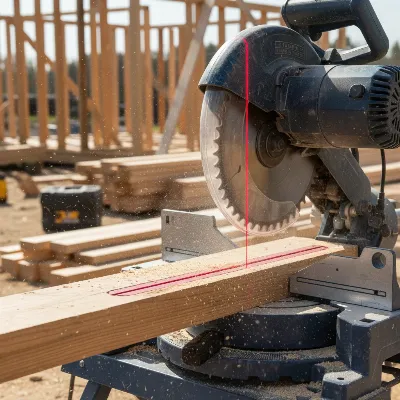 Miter saw with laser guide showing a precise cut line on a wooden beam.
Durability and Build Quality
A heavy-duty miter saw needs to withstand the rigors of a job site. Look for:
- Robust Construction: Military-grade aluminum frames, heavy-duty bearings, and overall solid construction contribute to longevity and stability, minimizing vibration and maintaining accuracy over time.
- Ergonomics: Comfortable handles and accessible controls improve usability during long workdays.
Dust Collection System
Framing generates a significant amount of sawdust. An effective dust collection system, whether a bag or a port for vacuum attachment, helps maintain a cleaner, safer workspace and improves cutline visibility. Top-tier systems can capture up to 90% of dust when connected to a vacuum.
Portability
If you frequently move your saw between job sites, portability is a factor. Lightweight aluminum construction and integrated carry handles make a significant difference. Cordless options also enhance mobility, though they typically trade some power or run-time for convenience.
Corded vs. Cordless
- Corded Saws: Offer consistent, maximum power for continuous, heavy-duty work without worrying about battery life. They are generally more powerful and cost-effective.
- Cordless Saws: Provide unparalleled convenience and mobility, especially on job sites without readily available power outlets. Modern cordless miter saws, especially 18V or 20V platforms, offer impressive power, though run-time can be a consideration for prolonged use.
Safety Features
Never overlook safety. Essential features include:
- Blade Guard: A transparent, automatic retracting blade guard is crucial to protect against accidental contact.
- Electric Brake: Stops the blade quickly after the trigger is released, reducing the risk of injury and allowing for faster repetitive cuts.
- Workpiece Clamps/Hold-downs: Help secure the material firmly against the fence and table, preventing kickback and ensuring stable, accurate cuts while keeping hands away from the blade.
- Stability: A wide, stable base prevents the saw from tipping during operation.
Brand and Price
Reputable brands like DeWalt, Bosch, Milwaukee, Metabo HPT, and Makita are known for their quality and reliability in the power tool industry. While heavy-duty miter saws represent a significant investment, opting for a well-regarded brand often means better performance, durability, and customer support. Consider it an investment in precision and efficiency for your framing projects.
3. Comparison of Popular Heavy Duty Miter Saws for Framing
The market offers several excellent heavy-duty miter saws suitable for framing. Here’s a comparison of some popular models often praised for their performance and features:
| Model | Blade Size | Amps | Type | Max Crosscut Capacity (approx.) | Key Features | Pros | Cons |
|---|---|---|---|---|---|---|---|
| DeWalt DWS780 | 12-inch | 15 | Sliding Dual Bevel | 2×16 (90°), 2×12 (45°) | XPS Cutline, efficient dust collection, durable construction. | Extremely accurate, powerful, wide cutting capacity, reliable. | Heavy, high price point. |
| DeWalt DWS779 | 12-inch | 15 | Sliding Dual Bevel | 2×16 (90°), 2×12 (45°) | Similar to DWS780 but often more budget-friendly, good dust collection. | Powerful, accurate, excellent value for performance. | May lack XPS light (depending on model/region), still heavy. |
| Bosch GCM12SD | 12-inch | 15 | Sliding Dual Bevel Glide | 14-inch (90°) | Axial-Glide system, upfront controls, large miter/bevel capacity. | Space-saving design, extremely smooth glide, precise, durable. | High price point, dust collection could be better, heavy. |
| Milwaukee M18 FUEL 2734-21 | 10-inch | Cordless | Sliding Dual Bevel | 2×12 (90°) | Cordless convenience, shadow cutline, portability. | Excellent portability, strong cordless power, good accuracy, durable. | 10-inch blade limits capacity vs. 12-inch, battery dependent, higher cost. |
| Metabo HPT C12RSH2S | 12-inch | 15 | Sliding Dual Bevel | 12.5-inch (90°) | Compact slide system, wide miter range (57°R/45°L), bevel (45°L/R). | Unique compact rail design, good cutting depth, great value. | Dust collection can be average, may require calibration out of the box. |
| Delta 26-2241 Cruzer | 10-inch | 15 | Sliding Dual Bevel | 16-inch (90°) | Military-grade aluminum, Shadow Guide, extending arms. | Exceptional crosscut capacity for a 10-inch, smooth glide, very durable. | 10-inch blade might not suit all heavy framing, somewhat heavy. |
Note: Cutting capacities are approximate and can vary based on specific lumber dimensions and blade settings.
4. Top Heavy Duty Miter Saws for Framing
Based on performance, durability, and features crucial for framing, here are some of the most highly-regarded heavy-duty miter saws for 2026:
DeWalt DWS780 12-Inch Double-Bevel Sliding Compound Miter Saw
The DeWalt DWS780 is consistently ranked among the best miter saws for professional use, particularly for framing. It’s a powerhouse designed for extensive use and high precision.
- Pros:
- Exceptional Accuracy: Equipped with DeWalt’s XPS cross-cut positioning system, it provides a highly visible LED-illuminated shadow line that indicates the exact cut path, ensuring precise cuts every time.
- Massive Cutting Capacity: The 12-inch blade combined with its sliding mechanism allows it to effortlessly cut through large framing lumber, including 2x16s at 90 degrees and 2x12s at 45 degrees.
- Powerful 15-Amp Motor: Easily handles dense hardwoods and thick framing materials without bogging down.
- Dual-Bevel Capability: Allows for bevel cuts up to 49 degrees in both directions, making complex compound cuts efficient without flipping the material.
- Durable Construction: Built with a sturdy design that withstands rigorous job site conditions, ensuring longevity and consistent performance.
- Cons:
- Weight: At around 56 pounds, it’s a heavy saw, which can make transport challenging without a dedicated stand.
- Price: It represents a significant investment, but its performance and durability often justify the cost for professionals.
- Ideal for: Any professional framer or serious DIYer tackling large-scale construction projects who needs uncompromising power, precision, and capacity.
Bosch GCM12SD 12-Inch Dual-Bevel Glide Miter Saw
The Bosch GCM12SD is renowned for its unique Axial-Glide system, which sets it apart from traditional sliding miter saws. This system offers unparalleled smoothness and a space-saving design, making it a favorite for many.
- Pros:
- Axial-Glide System: Provides incredibly smooth, consistent cutting action and eliminates the need for a rearward-extending slide, saving up to 12 inches of workspace. This is a huge benefit in crowded workshops or on tight job sites.
- Superior Accuracy: Known for its out-of-the-box accuracy and robust build, maintaining precise cuts over time.
- Wide Cutting Capacity: Offers a robust crosscut capacity of up to 14 inches at 90 degrees and significant vertical capacity for larger crown moldings.
- Upfront Controls: All miter and bevel adjustments are conveniently located at the front of the saw, making changes quick and easy.
- Powerful 15-Amp Motor: Delivers ample power for heavy framing applications.
- Cons:
- Price: Like the DWS780, it’s a premium tool with a premium price tag.
- Weight: Also a heavy machine, making portability a consideration.
- Dust Collection: While functional, some users find it can be improved compared to other top models.
- Ideal for: Professionals and serious enthusiasts who prioritize workspace efficiency, ultra-smooth operation, and uncompromising accuracy, especially in tighter environments.
Milwaukee M18 FUEL 10-Inch Dual Bevel Sliding Compound Miter Saw (2734-21)
For those prioritizing job site mobility and cordless convenience without sacrificing significant power, the Milwaukee M18 FUEL 10-inch miter saw is a top contender in the heavy-duty category.
- Pros:
- Cordless Freedom: Part of the M18 FUEL platform, offering the ultimate portability and flexibility on any job site.
- Powerful Performance: Despite being cordless, its POWERSTATE Brushless Motor delivers impressive cutting power comparable to many corded 10-inch saws, easily tackling framing lumber.
- Shadow Cutline: Features a reliable shadow cutline indicator for precise alignment, enhancing accuracy.
- Dual-Bevel Sliding Design: Provides a 2×12 crosscut capacity at 90 degrees and full dual-bevel capabilities, offering versatility for various framing cuts.
- Durable and Portable: Constructed with lightweight aluminum and integrated carry handles, making it relatively easy to move around.
- Cons:
- 10-inch Blade: While powerful for its size, a 10-inch blade has less ultimate capacity than 12-inch models for extremely wide or thick framing materials.
- Battery Life: Dependent on battery capacity; requires multiple batteries or frequent charging for extended, heavy use.
- Higher Cost (initial): The saw itself plus batteries and charger can be a significant upfront investment.
- Ideal for: Framers and remodelers who frequently work on diverse job sites where power outlets may be limited, valuing cordless convenience and robust performance for common framing dimensions.
5. Safe and Efficient Miter Saw Usage for Framing
Operating a heavy-duty miter saw safely and efficiently is paramount to protect yourself and ensure high-quality results for your framing projects.
Safety Precautions
- Always Wear Personal Protective Equipment (PPE): This includes safety glasses or goggles, hearing protection (earplugs or earmuffs), and potentially a dust mask, especially when cutting treated lumber or in enclosed spaces.
- Secure Your Workpiece: Always place your lumber firmly against the saw’s fence and table before making any cut. Use clamps or hold-downs whenever possible to prevent the material from shifting or kicking back.
- Maintain a Safe Distance: Keep your hands at least six inches away from the blade. Utilize a push stick or hold-down device for smaller pieces.
- Allow Blade to Reach Full Speed: Before beginning a cut, allow the blade to reach its full operating speed to prevent binding and ensure a clean cut.
- Wait for Blade to Stop: After completing a cut, keep the blade guard down and allow the blade to come to a complete stop before lifting the arm.
- Clear the Work Area: Keep your workspace free of scraps, sawdust, and any obstacles that could interfere with operation or cause tripping hazards.
Basic Cutting Techniques for Framing
- Crosscutting: For straightforward 90-degree cuts on studs or joists, simply set the miter angle to 0 degrees. Ensure the lumber is tightly against the fence.
- Miter Cutting: To create angled joints, adjust the miter table to the desired angle (e.g., 45 degrees for a corner). Always double-check your angle with a reliable protractor or speed square.
- Bevel Cutting: For sloped cuts, such as rafter tails, tilt the blade to the required bevel angle. Dual-bevel saws make this easier by allowing tilts in both directions.
- Compound Cutting: This combines miter and bevel settings. For example, cutting crown molding or complex roof components requires both horizontal and vertical angles. Practice on scrap pieces first to master the technique.
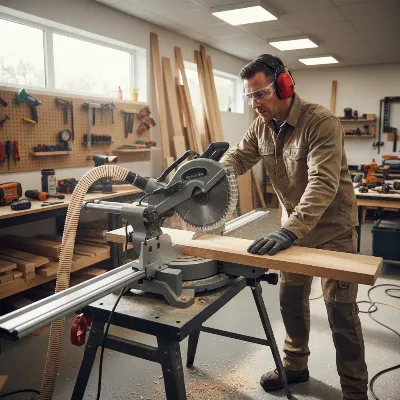 Carpenter safely using a heavy-duty miter saw to cut framing lumber, wearing safety glasses and hearing protection.
Tips for Efficient Usage
- Make Test Cuts: Especially for critical framing components or when setting up for complex angles, always make a test cut on a scrap piece of identical material to verify your settings and blade accuracy.
- Slow and Steady Push: Don’t force the blade through the material. A slow, consistent feed rate allows the saw to cut efficiently, reduces strain on the motor, and results in cleaner cuts.
- Utilize Stops and Supports: For repetitive cuts of the same length, set up a stop block. For long pieces of lumber, use outfeed supports to prevent the material from sagging, which can affect accuracy and safety.
- Regular Calibration Checks: Even the best saws can go out of alignment over time. Periodically check your saw’s 90-degree crosscut and 45-degree bevel stops with a precision square and adjust if necessary.
6. Miter Saw Maintenance and Cleaning
Proper maintenance and regular cleaning will extend the life of your heavy-duty miter saw and ensure its continued precision and safe operation.
- Unplug Before Maintenance: Always unplug the saw from its power source before performing any cleaning or maintenance.
- Clean Regularly: After each use, especially for framing, clear sawdust and debris from the saw table, fence, motor housing, and blade guard. Compressed air can be useful for hard-to-reach areas.
- Inspect the Blade: Check the blade for sharpness, damage, or missing teeth. A dull blade can lead to tear-out, binding, and motor strain. Replace or sharpen blades as needed.
- Clean the Slide Rails (if applicable): For sliding miter saws, keep the slide rails clean and free of sawdust. Apply a light coat of dry lubricant if recommended by the manufacturer to ensure smooth operation.
- Check Fasteners and Moving Parts: Periodically inspect all screws, bolts, and clamps to ensure they are tight. Lubricate pivot points and adjustment mechanisms according to the manufacturer’s guidelines.
- Dust Collection System: Ensure the dust port and bag/hose are clear and functioning correctly to maintain optimal dust extraction.
7. Where to Purchase Reliable Miter Saws
When investing in a heavy-duty miter saw for framing, it’s essential to purchase from reputable sources to ensure you receive an authentic product, warranty support, and reliable after-sales service.
- Authorized Retailers: Major home improvement stores like Lowe’s, The Home Depot, and Ace Hardware are authorized dealers for most leading brands. They often have saws on display, allowing you to physically examine them.
- Online Retailers: Websites like Amazon, Acme Tools, and other specialized tool dealers offer a wide selection, often with competitive pricing and detailed customer reviews. Always ensure you are buying from the official brand store or a verified reseller.
- Specialty Tool Shops: Local tool shops may offer personalized advice and support, which can be invaluable, especially for high-end tools.
Always compare prices, read recent reviews, and check the warranty information before making a purchase.
Conclusion
Choosing the best heavy-duty miter saw for framing is a critical decision that impacts the efficiency, accuracy, and structural integrity of your projects. By prioritizing features like a powerful 15-amp motor, a 12-inch sliding dual-bevel blade, and advanced accuracy systems, you equip yourself with a tool capable of tackling the toughest framing challenges. Whether you opt for the raw power and precision of a DeWalt DWS780, the innovative space-saving design of the Bosch GCM12SD, or the cordless freedom of the Milwaukee M18 FUEL, investing in a high-quality miter saw is an investment in your craftsmanship.
With the right heavy-duty miter saw, combined with diligent safety practices and regular maintenance, you’ll be well-prepared to make precise, strong cuts for any framing endeavor. What will be the first major framing project you tackle with your new, powerful miter saw?
Frequently Asked Questions
What makes a miter saw “heavy-duty” for framing?
A heavy-duty miter saw for framing typically features a powerful 15-amp motor, a large 12-inch blade, and a sliding mechanism to handle wide lumber. It also prioritizes durable construction, stable fences, and precise angle adjustments crucial for structural work.
Is a 10-inch or 12-inch miter saw better for framing?
For most heavy-duty framing, a 12-inch miter saw is generally better. Its larger blade diameter allows for deeper and wider cuts, accommodating common framing lumber dimensions like 2x10s, 2x12s, and 4x4s more easily, especially with a sliding feature.
Can a cordless miter saw handle heavy-duty framing?
Yes, modern cordless miter saws, particularly those on 18V or 20V platforms like the Milwaukee M18 FUEL, can handle heavy-duty framing tasks. They offer significant power and the convenience of portability, though their cutting capacity might be slightly less than top-tier 12-inch corded saws, and battery life needs managing for continuous use.
What is the most important safety feature on a miter saw for framing?
While all safety features are critical, a reliable blade guard that fully covers the blade when not cutting, combined with workpiece clamps or hold-downs to prevent material movement, are arguably the most important for minimizing accident risk during heavy-duty framing.
How to Use a Miter Saw Safely and Efficiently for Framing
Operating a heavy-duty miter saw safely and efficiently is paramount to protect yourself and ensure high-quality results for your framing projects. Follow these steps for optimal performance and safety.
Always wear safety glasses, hearing protection, and a dust mask. Firmly place your lumber against the saw's fence and table, using clamps or hold-downs to prevent shifting or kickback.
Before beginning any cut, allow the blade to reach its full operating speed. This prevents binding and ensures a clean, efficient cut through the material.
For crosscuts, set the miter angle to 0 degrees. For miter cuts, adjust the table to the desired angle (e.g., 45 degrees). For bevel cuts, tilt the blade to the required angle; dual-bevel saws simplify this.
Always make a test cut on scrap material to verify settings and accuracy, especially for critical components. For long pieces, use outfeed supports to prevent sagging and maintain accuracy.
Unplug the saw before cleaning. After each use, clear sawdust and debris from the table, fence, and blade guard. Inspect the blade for sharpness and ensure slide rails are clean and lubricated.
Get our weekly buyer guide
Practical specs, not advice. Unsubscribe anytime.

The Bosch GCM12SD has been a solid performer for my garage build. I really appreciate the smooth glide and the precision it offers, especially with those 12-inch blades. My only minor gripe is that it’s a bit heavier than I expected, making it a little cumbersome to move around the job site by myself. Still, it cuts like a dream.
I recently upgraded to the DeWalt DWS780 after struggling with an older saw for a framing project. The dual-bevel sliding feature is a game-changer for cutting large lumber quickly and accurately. It’s incredibly powerful and makes quick work of even thick beams. Definitely worth the investment for serious DIYers or pros.
This saw is a beast! I’ve been using a 15-amp motor saw for all my framing work, and the power is just unmatched. It slices through 2x10s like butter, and the accuracy for repetitive cuts is spot on. My construction quality has definitely improved since I started using a proper heavy-duty miter saw.
I picked up the Milwaukee M18 FUEL 2734-21 for its cordless convenience, which is great for working without outlets. However, I’ve noticed that for really heavy-duty, all-day framing, the battery life can be a bit limiting. I have to keep a few extra batteries charged to avoid interruptions. It’s powerful, but plan for battery swaps.