The Ryobi 18V ONE+ Cordless Miter Saw series offers portable cutting solutions for woodworking and DIY projects, with models like the 7-1/4″ Sliding Compound and 10″ HP Brushless providing distinct advantages. The 7-1/4″ model excels for DIYers and light tasks due to its portability and affordability, while the 10″ HP Brushless model handles more demanding projects with greater capacity and power, especially when paired with High Performance batteries. Both models feature cordless operation, effective dust collection, and reliable accuracy through an LED shadow line.
What is a Miter Saw?
A miter saw is a specialized power tool designed for making accurate crosscuts and miter cuts in a workpiece. Unlike a standard circular saw, it features a mounted blade that pivots and tilts, allowing users to precisely set cutting angles for tasks like framing, trim work, and crafting furniture. These tools are crucial for achieving tight-fitting joints and professional finishes that would be challenging to accomplish with less specialized equipment.
Miter saws come in several types, each offering different functionalities. Basic miter saws perform straight crosscuts and angled miter cuts. Compound miter saws add the ability to bevel the blade, allowing for angled cuts on two planes simultaneously. Sliding compound miter saws further extend the crosscut capacity by allowing the blade to slide forward and backward on rails, handling wider material. Cordless miter saws, like the Ryobi 18V ONE+ series, bring unparalleled portability to these capabilities, freeing users from the constraints of power outlets and extension cords.
Ryobi 18V ONE+ Cordless Miter Saws: An Overview
The Ryobi 18V ONE+ system has become a staple for many, celebrated for its expansive range of tools that all operate on the same interchangeable battery platform. This ecosystem brings significant advantages, primarily portability and cost-effectiveness for users already invested in Ryobi’s batteries and chargers. The cordless nature of these miter saws makes them incredibly versatile, perfect for job sites where power access is limited, or for tackling projects in various locations around a home or workshop.
Within the Ryobi 18V ONE+ lineup, two prominent cordless miter saw models cater to different user needs: the 7-1/4″ Sliding Compound Miter Saw (often seen as model PBT01B) and the 10″ HP Brushless Sliding Miter Saw. The 7-1/4″ model is particularly favored by DIYers and those needing a lightweight, compact solution for smaller projects and trim work. The 10″ HP Brushless variant steps up in capacity and power, aiming to serve more demanding users and larger stock materials, leveraging Ryobi’s High Performance (HP) battery technology for optimized output. Both emphasize the convenience of cordless operation, making them attractive options for mobile woodworking.
In-Depth Review: Ryobi 18V ONE+ Cordless Miter Saw Performance
Evaluating a miter saw’s performance hinges on several critical factors, including its cutting capacity, accuracy, power delivery, and battery life. The Ryobi 18V ONE+ Cordless Miter Saws offer a compelling balance across these metrics, particularly for their intended market.
Cutting Capacity and Power
|
Our Picks for the Best Miter Saw in 2026
As an Amazon Associate I earn from qualifying purchases.
|
||
| Num | Product | Action |
|---|---|---|
| 1 | Metabo HPT 12-Inch Compound Miter Saw | Xact Cut LED Shadow Line System | Dual Bevel | C12FDHB |

|
| 2 | SKIL 3601-02 Flooring Saw with 36T Contractor Blade, Red and black |
|
| 3 | WEN Universal Collapsible Miter Saw Stand, 350-Pound Capacity (MSA200) |
|
| 4 | Olson Saw 35-241 Fine Kerf Saw 35-550 42 tpi with Aluminum Thin Slot Miter Box, Slot Size .014-Inch, Slot Angles 45, 60, 90, Cutting Depth 7/8-Inch, Pack of 1 |
|
| 5 | WEN MM0713 9.5-Amp 7.25-Inch Single Bevel Compact Sliding Compound Miter Saw with LED Cutline Guide, Black |
|
| 6 | Makita LS0816F 8-1/2” Slide Compound Miter Saw |
|
| 7 | Stanley 1-20-600 Saw Storage Miter Box with Saw, Black |
|
| 8 | HAUTMEC 14 Inch Clamping Miter Box with Adjustable Jaw & 4 Anti-Slip Clamps, Heavy Duty ABS Mitre Saw Box with 22.5°, 45°, 90° Cutting Angles for Woodworking, Trim, Frames, DIY Projects – HTHDM25036 |
|
| 9 | Seesii Mini Circular Saw with Laser Guide,4.8A 4000 RPM Compact Corded Circular Saw with Rip Guide,3 Blades (4-1/2") for Wood,Soft Metal,Tile,Plastic Cutting,Max Cut Depth 1-11/16"(90°),1-1/8" (45°) |
|
| 10 | Miter Saw Laser Guide - Miter and Portable Saw Laser Guide, Miter & Portable Saws |
|
The Ryobi 18V ONE+ 7-1/4″ Sliding Compound Miter Saw demonstrates commendable cutting capacity for its size. It effortlessly cuts through softwood applications like pine, fir, and cedar, producing clean results. This model can manage crosscuts through 2×10 lumber and miter cuts through 2×8 lumber, making it suitable for a wide range of common tasks. However, independent reviews indicate that it may struggle with power during rapid or continuous cuts, especially with harder materials like aluminum, where a slower pace is recommended to prevent the blade from bogging down or stopping. Its no-load RPM is around 3450, which is adequate for light to medium-duty tasks.
In contrast, the Ryobi 18V ONE+ HP Brushless 10″ Sliding Miter Saw significantly expands its cutting capabilities. It is capable of making 90° crosscuts in both 2×12 and 4×6 materials, and can handle 2×8 lumber at a 45° bevel or compound miter cut. This model, particularly when paired with Ryobi’s High Performance batteries, delivers more power than might be expected from an 18V system, positioning it for more professional-level tasks. Its brushless motor generates 4,100 RPM, offering smoother and more consistent power delivery across cuts.
Accuracy and Precision
Accuracy is paramount for any miter saw, and Ryobi has integrated features to enhance cut precision. Many Ryobi cordless miter saws, including the 10-inch HP Brushless model, feature an LED alignment aid. This system casts a thin shadow of the blade onto the workpiece, providing a clear indication of the cutline. Many users and reviewers often prefer this shadow line approach over traditional laser guides, finding it more consistent and easier to align for precise cuts. However, some 7-1/4″ models might lack a direct laser or LED cut line indicator, relying on manual alignment which may necessitate more frequent calibration checks.
The saws typically feature positive stops at common miter angles (such as 15°, 22.5°, 30°, and 45°), allowing for quick and secure adjustments. While the PBT01B 7-1/4″ model is a single bevel saw, capable of tilting up to 45° to the left, the 10-inch model also offers single bevel functionality up to 45° to the left. Some independent tests indicate that while generally precise, occasional recalibration might be necessary to maintain optimal accuracy, with minor deviations (0.2 to 0.5 degrees) observed on 45-degree miter angles after heavy use.
> “The greatest advantage of modern cordless miter saws is not just their mobility, but their ability to deliver consistent power and accuracy on par with corded counterparts, making job site flexibility a real major upgrade.”
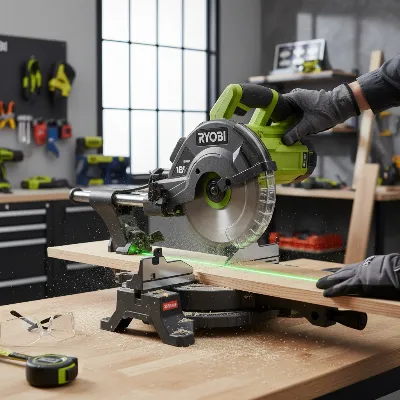 A close-up shot of a Ryobi 18V ONE+ Cordless Miter Saw making a precise cut on a wooden plank with an LED shadow line, showcasing accuracy in a workshop setting with safety glasses and sawdust visible.
Battery Life and Runtime
Battery performance is a critical consideration for any cordless tool, especially a power-intensive one like a miter saw. The Ryobi 18V ONE+ system offers various battery capacities, significantly impacting runtime. For the 7-1/4″ sliding compound model, a 4.0Ah battery is reported to deliver approximately 400-500 cuts through 2×4 lumber. Upgrading to a 6.0Ah battery can extend this to 600-900 cuts. Some older 18V models were noted to achieve around 80-90 cuts on a single 18V battery, potentially reaching 100 cuts with two 18V batteries for a cumulative 36V output, which can be beneficial for relentless cutting tasks.
For the HP Brushless models, using Ryobi’s High Performance batteries is highly recommended. These batteries are designed to unlock the saw’s full potential, ensuring optimal power and extended runtime, especially during more demanding applications. Battery life will always vary based on the material being cut, the cutting depth, and the battery’s age and charge level.
Portability and Design
One of the standout advantages of the Ryobi 18V ONE+ Cordless Miter Saws is their exceptional portability. The 7-1/4″ model weighs around 33-34 pounds, making it incredibly easy to transport around a job site or to different areas of a workshop. The 10-inch HP Brushless model is also recognized for its mobility. This lightweight and compact design allows for quick setup and breakdown, significantly enhancing flexibility and productivity for trim work, punch list items, and various home renovation tasks where mobility is key.
Regarding design, the sliding compound mechanisms on both models allow for wider crosscuts than standard non-sliding saws. The 10-inch model utilizes a dual-rail system, which contributes to a stable head unit with minimal play, ensuring the blade stays true during long cuts. Some models, like the 7-1/4″ PBT01B, feature fixed plastic table extensions. While these provide support, they are non-adjustable, which could be a minor limitation for some users. The miter adjustment on the 10-inch saw, while sometimes described as stiff, operates smoothly with confident detents.
Dust Collection
Effective dust collection is essential for a clean and safe workspace, and the Ryobi 18V ONE+ miter saws generally perform well in this regard. The 7-1/4″ model, for instance, has been noted for its commendable dust collection system, outperforming some lower-end saws. It often features a rigid dust chute directly behind the blade, preventing collapse under vacuum suction, a common issue with some other models. While not reaching the levels of high-end professional saws, the dust collection system, whether using the included bag or connecting to a vacuum, is considered above average for its class. The 10-inch model also offers effective dust management.
Build Quality
While generally considered robust enough for DIY and light professional use, some older or entry-level Ryobi 18V miter saw models have received feedback about average build quality. Specifically, their lightweight profile can sometimes lead to the head and miter lock system feeling less substantial than heavier, corded counterparts. However, for the price point and the convenience of cordless operation, the build quality is typically acceptable, balancing durability with portability. Newer HP Brushless models often feature improved construction that contributes to enhanced stability and longevity.
Choosing the Right Ryobi 18V ONE+ Miter Saw for Your Needs
Selecting the ideal miter saw requires a clear understanding of your specific requirements and how different features align with your projects. Ryobi’s cordless offerings provide compelling options, but knowing which model suits you best is key.
Identify Your Projects
Consider the type and scale of your typical work. Are you primarily a DIY enthusiast tackling home renovations, small furniture, or trim work? The Ryobi 18V ONE+ 7-1/4″ Sliding Compound Miter Saw is often highlighted as an excellent budget-friendly battery-powered option for these scenarios. Its compact size and portability make it ideal for quick, accurate cuts without the hassle of cords.
If your projects involve cutting larger dimensional lumber, framing, or more frequent use, the Ryobi 18V ONE+ HP Brushless 10″ Sliding Miter Saw might be a better investment. Its increased blade size and higher power output (especially with HP batteries) cater to more demanding tasks, offering a step up in capacity and performance for value-focused professionals or serious hobbyists.
Key Factors to Consider
- Blade Size and Cut Capacity: A 7-1/4″ blade is excellent for smaller stock and trim. A 10″ blade significantly increases crosscut and vertical capacity, handling wider and thicker materials with ease. Assess the maximum dimensions of the wood you typically work with.
- Motor Type and Power Requirements: Brushless motors, found in Ryobi’s HP models, offer greater efficiency, longer runtime, and more power than brushed motors. For consistent performance, especially on thicker or harder materials, prioritize brushless models and pair them with high-capacity or High Performance batteries.
- Bevel Capabilities (Single vs. Dual): The Ryobi 18V ONE+ miter saws typically offer single bevel functionality, meaning they tilt in one direction (usually left). For intricate crown molding or complex angled cuts that require beveling in both directions without flipping the workpiece, a dual-bevel saw would be more efficient, though less common in this specific cordless Ryobi lineup.
- Accuracy Features (LED, Detents): The LED shadow line is a reliable feature for guiding cuts. Ensure the miter and bevel detents are easy to adjust and lock securely for repeatable accuracy.
- Portability vs. Stationary Use: If you frequently move your saw between locations, the lightweight nature of the Ryobi cordless models is a significant advantage. For a permanent workshop setup, while still beneficial, portability might be less of a primary driver.
- Budget and ONE+ Ecosystem: Ryobi tools are generally more affordable than many professional-grade alternatives. If you already own Ryobi 18V ONE+ batteries and a charger, investing in a bare tool (saw only) can be highly cost-effective, leveraging your existing battery infrastructure.
Ryobi 18V ONE+ Cordless Miter Saw Comparison Table
| Feature | Ryobi 18V ONE+ 7-1/4″ Sliding Compound (PBT01B) | Ryobi 18V ONE+ HP Brushless 10″ Sliding Miter Saw (e.g., PBLMS01B) |
|---|---|---|
| Blade Size | 7-1/4 inches | 10 inches |
| Motor Type | Brushless (for specific models) | HP Brushless |
| Max Crosscut (90°) | 2×10 lumber (sliding) | 2×12 / 4×6 lumber (sliding) |
| Max Miter (45°) | 2×8 lumber (sliding) | 2×8 lumber |
| Bevel Capacity | Single Bevel (up to 45° left) | Single Bevel (up to 45° left) |
| RPM (No-load) | ~3450 RPM | 4100 RPM |
| Weight | ~33-34 lbs | ~33 lbs |
| Cutline Indicator | LED shadow line (varies by specific model) | LED alignment aid (shadow line) |
| Dust Collection | Good | Effective |
| Target User | DIY, light to medium tasks, portability | DIY, value-focused pro, higher capacity, portability |
| Approx. Price (Tool Only) | ~$239 | ~$299-$399 |
Safe and Effective Operation of Your Ryobi Miter Saw
Operating any power tool, especially a miter saw, demands strict adherence to safety protocols to prevent accidents and ensure consistent results. Safety should always be your top priority.
Pre-operation Safety
Before making any cut, always equip yourself with essential personal protective equipment (PPE), including safety glasses or goggles, hearing protection, and a dust mask or respirator. Ensure your workspace is clean, well-lit, and clutter-free to avoid tripping hazards. The miter saw must be placed on a sturdy, level workbench or stand and secured if prone to tipping. Always check the blade for sharpness and ensure it’s correctly installed and free from damage. Inspect the blade guard to confirm it moves freely and effectively covers the blade.
Making Cuts
Once your safety gear is on and the saw is set up, to secure your workpiece firmly with clamps whenever possible to prevent movement during the cut. Never attempt to hold the workpiece freehand. Before lowering the blade into the material, allow the saw blade to reach its full speed. Apply gentle, steady pressure throughout the cut, letting the saw do the work; forcing the blade can lead to kickback or damage. After the cut is complete, release the trigger and wait for the blade to come to a complete stop before raising the saw arm and removing the workpiece.
Common Mistakes to Avoid
Many beginners make common mistakes that can compromise safety and cut quality. Never reach underneath the work or into the blade’s cutting path while the saw is running or coasting. Avoid awkward operations or hand positions where a sudden slip could bring your hand near the blade. Always ensure you have good balance and never operate the miter saw on the floor or in a crouched position. Rapidly turning the motor switch on and off can also strain the tool and should be avoided. Consistent practice with a focus on these safety measures will make your miter saw operation both safer and more efficient.
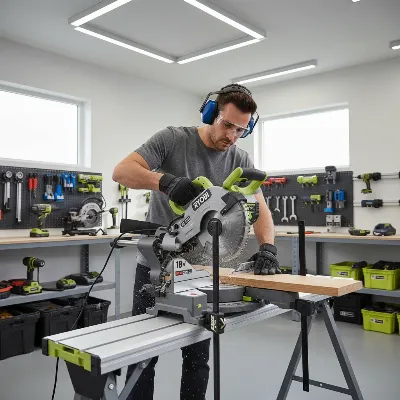 A person wearing safety glasses and ear protection operating a Ryobi 18V ONE+ Cordless Miter Saw, demonstrating proper safety posture and workpiece clamping in a bright, clean workshop environment.
Maintenance and Cleaning for Longevity
Regular maintenance is crucial for extending the lifespan of your Ryobi 18V ONE+ miter saw, ensuring it continues to deliver precise and efficient cuts. A well-maintained tool performs better and is safer to operate.
After every use, clean your saw thoroughly. Use a brush or compressed air to remove sawdust and debris from the blade guard, table, fence, and motor vents. Pay close attention to the area around the blade and miter gauge, as fine dust can accumulate and interfere with smooth operation.
Inspect your blade regularly. A dull or damaged blade not only reduces cutting quality but also puts extra strain on the motor. Replace or sharpen the blade as needed, ensuring it’s always sharp and properly set. Lubricate pivot points and hinges with a light machine oil recommended by the manufacturer to keep moving parts operating smoothly.
Periodically check the alignment and calibration of your saw. Use a reliable square to verify the fence’s squareness to the base and the blade’s angle. Adjust the miter detent stops and bevel angle as necessary, referring to your saw’s user manual for specific instructions. to keep the dust collection system clear, emptying the bag or vacuum frequently to maintain efficiency and prevent buildup. For cordless models, also inspect your battery packs and charger for any signs of wear or damage.
Where to Purchase Ryobi 18V ONE+ Miter Saws
Ryobi 18V ONE+ Cordless Miter Saws are widely available through various retailers, making them accessible to a broad audience. You can typically find these tools at major home improvement stores, both in-store and online. Online marketplaces and authorized Ryobi dealers also carry a selection of models, often providing competitive pricing and product information. When purchasing, consider buying from reputable vendors to ensure you receive genuine products and can access customer support and warranty services if needed.
Conclusion
The Ryobi 18V ONE+ Cordless Miter Saw series, particularly the 7-1/4″ Sliding Compound and 10″ HP Brushless models, represents a significant stride in offering portable cutting solutions without compromising essential functionality. While the 7-1/4″ excels for DIYers and light to medium tasks with its exceptional portability and affordability, the 10″ HP Brushless model steps up for more demanding projects requiring greater capacity and power, especially when paired with High Performance batteries. Both provide the freedom of cordless operation, good dust collection, and reliable accuracy through features like the LED shadow line.
Whether you’re a weekend warrior tackling home projects or a value-conscious professional needing mobility on the job site, Ryobi offers a cordless miter saw that can meet your needs. By understanding your specific project requirements and the capabilities of each model, you can confidently choose a tool that enhances your productivity and precision. What kind of project will you tackle first with your new Ryobi 18V ONE+ Cordless Miter Saw?
Frequently Asked Questions
How many cuts can a Ryobi 18V miter saw make on one battery?
The number of cuts varies by battery capacity and material. A 4.0Ah battery on a 7-1/4″ sliding compound model can provide approximately 400-500 cuts through 2×4 lumber, while a 6.0Ah battery can extend this to 600-900 cuts. Using High Performance batteries with HP Brushless models can also optimize runtime.
Is the Ryobi 18V miter saw good for professional use?
The Ryobi 18V miter saws are generally well-suited for light to medium-duty professional applications, especially where portability is a key factor, such as trim work or punch list items. For heavy-duty, continuous framing, or cutting very dense materials, some professionals might prefer a corded saw or a higher-voltage cordless system, but the 10″ HP Brushless model with HP batteries offers impressive capability for an 18V platform.
What’s the difference between the 7-1/4″ and 10″ Ryobi cordless miter saws?
The primary differences lie in blade size, cutting capacity, and power. The 7-1/4″ model is more compact and lighter, ideal for smaller projects and trim. The 10″ model offers greater crosscut capacity (e.g., 2×12 vs. 2×10 lumber) and typically features a more powerful HP Brushless motor, making it suitable for larger stock and more demanding tasks.
Does the Ryobi 18V miter saw have a laser guide?
Many Ryobi 18V miter saws, especially the newer models like the 10″ HP Brushless, feature an LED alignment aid. This system casts a shadow of the blade onto the workpiece, providing a clear cutline. While not a traditional laser, many users find this shadow line method more accurate and consistent. Some 7-1/4″ models might rely on visual alignment without a dedicated cut line indicator.
How do I calibrate my Ryobi miter saw for accurate cuts?
To calibrate your Ryobi miter saw, you’ll need a reliable square. Check the fence to ensure it’s square to the base and the blade is perpendicular to the table at 0 degrees. Adjust the miter detent stops and bevel angles as necessary, following the specific instructions in your saw’s user manual. Regular calibration checks are advisable to maintain optimal precision.
Operating Your Ryobi Miter Saw Safely and Effectively
Learn how to safely set up, operate, and maintain your Ryobi 18V ONE+ miter saw for precise and efficient cuts, ensuring longevity and preventing accidents.
Always wear safety glasses, hearing protection, and a dust mask. Ensure your workspace is clean, well-lit, and clutter-free. Place the miter saw on a sturdy, level surface and secure it to prevent tipping.
Secure your workpiece firmly with clamps; never hold it freehand. Allow the blade to reach full speed before cutting. Apply gentle, steady pressure throughout the cut, letting the saw do the work. Release the trigger and wait for the blade to stop completely before removing the workpiece.
After each use, clean sawdust and debris from the saw using a brush or compressed air. Inspect the blade for sharpness and replace or sharpen as needed. Lubricate pivot points and hinges with light machine oil to ensure smooth operation.
Periodically check the alignment and calibration of your saw using a reliable square. Verify the fence's squareness to the base and the blade's angle. Adjust miter detent stops and bevel angles according to your user manual to maintain optimal accuracy.
Get our weekly buyer guide
Practical specs, not advice. Unsubscribe anytime.

This Ryobi 18V ONE+ miter saw is exactly what I needed for my deck project. The cordless operation was a huge plus, as I didn’t have to worry about running extension cords all over the yard. I was impressed with how well it handled all the crosscuts and miter cuts for the railing. Great value and performance for a cordless tool.
I got the 7-1/4″ model hoping for a super lightweight option for trim work. It’s good for quick cuts, but I found the fence to be a little finicky to get perfectly square sometimes. For the affordability, it’s decent, but I might upgrade to something with a more robust fence system down the line if I do more precision work. It’s fine for general framing though.
I picked up the 7-1/4″ Sliding Compound Ryobi miter saw for my garage workshop, and it’s been a game-changer for my DIY projects. The portability is fantastic; I can easily move it around or even take it to a friend’s house for help with their renos. The LED shadow line is surprisingly accurate and makes setting up cuts a breeze. Definitely recommend for anyone doing light to medium woodworking.
I’ve been using the 10″ HP Brushless model for a few months now, mostly for building custom furniture. The power is definitely there, especially when I use my High Performance batteries, and it handles thicker stock without bogging down. My only minor complaint is that the dust collection, while effective, still leaves a bit more sawdust than I’d like. Still, it’s a solid tool for the price.