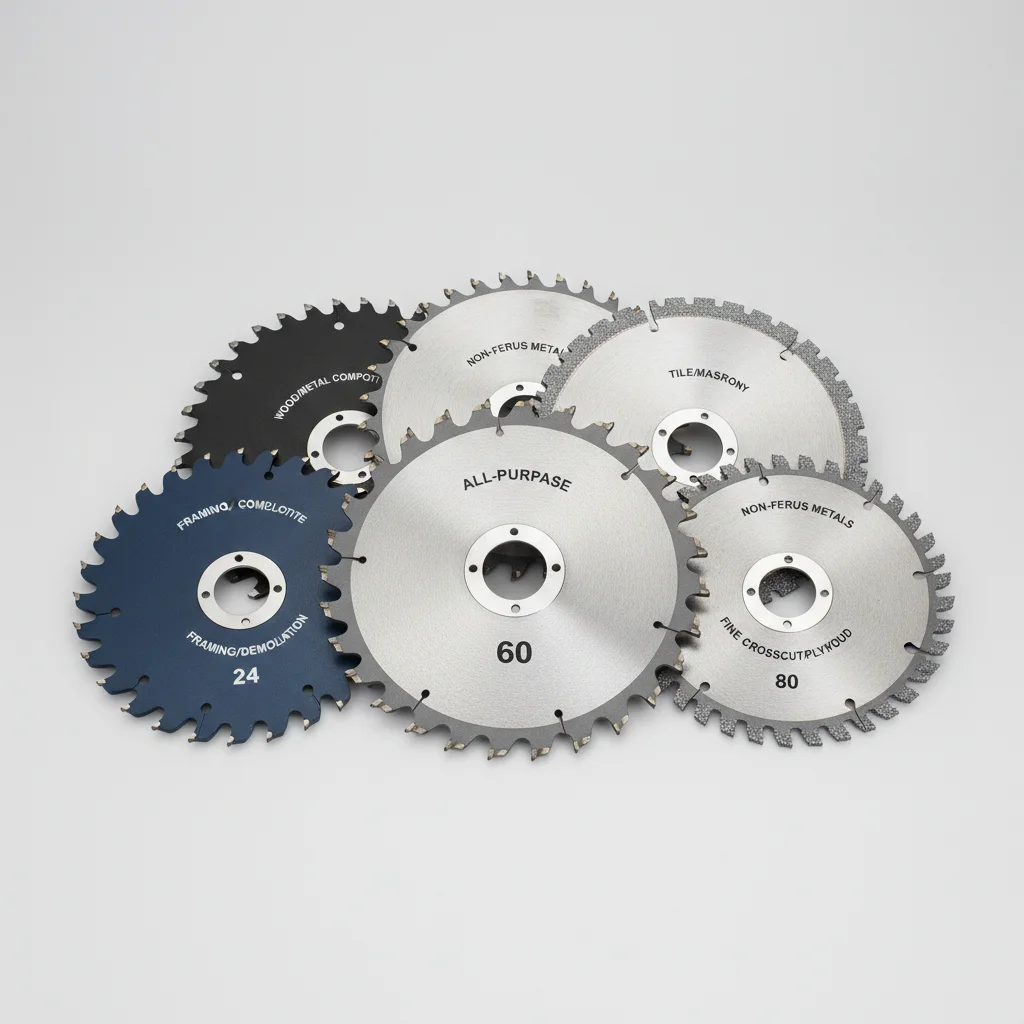
Choosing the correct miter saw blade type is crucial for achieving precise, clean cuts and ensuring safety in your woodworking and DIY projects. There are five primary types of miter saw blades, each designed for specific materials and cutting tasks. Understanding these differences will significantly improve the quality of your work and the longevity of your tools.
Understanding Miter Saw Blade Anatomy
Before diving into specific types, it’s helpful to understand the basic components of a miter saw blade. Key elements include the blade diameter, arbor size, tooth count, hook angle, and kerf. The diameter must match your saw’s specifications, while the arbor size ensures proper mounting. Tooth count dictates the smoothness of the cut, with more teeth generally yielding finer results. The hook angle affects how aggressively the blade cuts, and the kerf is the width of the cut made by the blade.
Crosscutting Blades for Fine Finishes
Crosscutting blades are specifically designed for cutting across the grain of wood, producing very clean and smooth finishes. These blades typically have a higher tooth count, often ranging from 60 to 100 teeth for a 10-inch or 12-inch blade. The teeth are usually ATB (Alternate Top Bevel) ground, which helps to shear the wood fibers cleanly, minimizing tear-out. They are ideal for trim work, cabinetry, and any application where a pristine finish is paramount. Using a crosscutting blade for ripping (cutting with the grain) is not recommended as it can lead to excessive heat buildup and a poor cut.
Ripping Blades for Efficient Grain Cuts
Ripping blades are engineered for cutting along the grain of wood. They feature a lower tooth count, typically between 24 and 40 teeth for a standard 10-inch or 12-inch blade. These teeth are often FTG (Flat Top Grind) or a combination grind, designed to quickly remove material. The larger gullets between the teeth allow for efficient chip ejection, preventing the blade from binding. While excellent for ripping, these blades will produce a rougher cut when used for crosscutting and are not suitable for fine finish work.
Combination Blades: Versatility for Various Tasks
|
Our Picks for the Best Miter Saw in 2026
As an Amazon Associate I earn from qualifying purchases.
|
||
| Num | Product | Action |
|---|---|---|
| 1 | WEN Universal Collapsible Miter Saw Stand, 350-Pound Capacity (MSA200) |

|
| 2 | Miter Saw Laser Guide - Miter and Portable Saw Laser Guide, Miter & Portable Saws |
|
| 3 | Seesii Mini Circular Saw with Laser Guide,4.8A 4000 RPM Compact Corded Circular Saw with Rip Guide,3 Blades (4-1/2") for Wood,Soft Metal,Tile,Plastic Cutting,Max Cut Depth 1-11/16"(90°),1-1/8" (45°) |
|
| 4 | WEN MM0713 9.5-Amp 7.25-Inch Single Bevel Compact Sliding Compound Miter Saw with LED Cutline Guide, Black |
|
| 5 | Metabo HPT 12-Inch Compound Miter Saw | Xact Cut LED Shadow Line System | Dual Bevel | C12FDHB |
|
| 6 | Olson Saw 35-241 Fine Kerf Saw 35-550 42 tpi with Aluminum Thin Slot Miter Box, Slot Size .014-Inch, Slot Angles 45, 60, 90, Cutting Depth 7/8-Inch, Pack of 1 |
|
| 7 | Stanley 1-20-600 Saw Storage Miter Box with Saw, Black |
|
| 8 | SKIL 3601-02 Flooring Saw with 36T Contractor Blade, Red and black |
|
| 9 | Makita LS0816F 8-1/2” Slide Compound Miter Saw |
|
| 10 | HAUTMEC 14 Inch Clamping Miter Box with Adjustable Jaw & 4 Anti-Slip Clamps, Heavy Duty ABS Mitre Saw Box with 22.5°, 45°, 90° Cutting Angles for Woodworking, Trim, Frames, DIY Projects – HTHDM25036 |
|
Combination blades offer a balance between crosscutting and ripping capabilities, making them a versatile choice for many woodworkers. They typically feature groups of ATB teeth followed by a single FTG tooth, with a medium tooth count (around 50-80 teeth). This design allows them to perform reasonably well for both cutting across and along the grain. While they may not achieve the absolute finest finish of a dedicated crosscutting blade or the speed of a dedicated ripping blade, they are an excellent all-around option for general woodworking and DIY projects where frequent blade changes are impractical.
Specialty Blades for Unique Materials
Beyond general woodworking, there are several specialty miter saw blades designed for specific materials. These include:
- Non-Ferrous Metal Blades: These blades have a high tooth count and specific tooth geometry, often TCG (Triple Chip Grind), to cut aluminum, brass, and other soft metals without damaging the blade or the material.
- Laminate and Plywood Blades: Featuring a very high tooth count and often a negative hook angle, these blades are designed to minimize chipping and tear-out when cutting veneered plywood, melamine, and laminate flooring.
- Dado Blades: While not typically used on a miter saw, dado blades are worth mentioning for their ability to cut grooves and dados. If your miter saw allows, a wobble dado or stacked dado set can be used for specific joinery tasks.
- Fiber Cement Blades: These blades are designed with polycrystalline diamond (PCD) tips to withstand the abrasive nature of fiber cement siding.
- Plastic/Acrylic Blades: Similar to non-ferrous metal blades, these often have a high tooth count and specific grind to prevent melting and chipping when cutting plastics.
Choosing the Right Blade for Your Project
When selecting a miter saw blade, consider the material you’re cutting, the desired finish, and the type of cut (crosscut, rip, or combination). For fine finish work on hardwoods and softwoods, a high-tooth-count crosscutting blade is ideal. For rough framing or quickly breaking down lumber, a lower-tooth-count ripping blade will be more efficient. For general-purpose use, a good quality combination blade can save time and effort. Always ensure the blade’s diameter and arbor size match your miter saw’s specifications.
Get our weekly buyer guide
Practical specs, not advice. Unsubscribe anytime.
